
The Orbitant Operational Architecture: How a Spanish Tech Firm is Rewriting the Rules of Tech Consulting
In an industry heavily populated by volume-driven body shops and rigid waterfall contracts, the traditional IT consultancy model has earned a healthy dose of market skepticism. Clients are tired of hidden scopes, communication bottlenecks, and "tech for tech’s sake."
Orbitant is actively dismantling that skepticism.
Operating out of Madrid, Spain, the firm's leadership team are not new to navigating complex technical landscapes. Having worked seamlessly together for over ten years, the core team previously built and successfully sold a proprietary Fintech software called Sherpa platform to a huge Spanish Professional Services. Founding a new company as Orbitant in 2025, they leveraged that hard-earned market credibility to rapidly scale a highly specialized team of 50 personnel.
But it is not their headcount that makes Orbitant formidable; it is their complete rejection of traditional IT operations.
The 'Forward Deployed Engineer' Philosophy: Orbitant operates on a flat hierarchy, eliminating traditional project managers entirely. Instead, they deploy "Forward Deployed Engineers” - technical experts empowered to act as direct problem solvers. These engineers operate in squads of at least two and integrate directly into the client's daily operations, a philosophy Orbitant refers to as "wearing the client's t-shirt." By removing the middleman, engineers from junior to senior levels speak directly with stakeholders.
And in their own words: "we are a tech consultancy with focus on AI-Engineering, we build platforms, products and agents leveraged in our own methodology with AI. We put focus on R&D, we build our own products to learn and we have a really strong culture focused on sharing knowledge and continuous learning. So the forward deployed engineer is a service that has become really important in the AI era where the engineer needs to put more and more focus on the product and business and not just in coding, so understanding the client's business is absolutely essential and is where we add most value.”
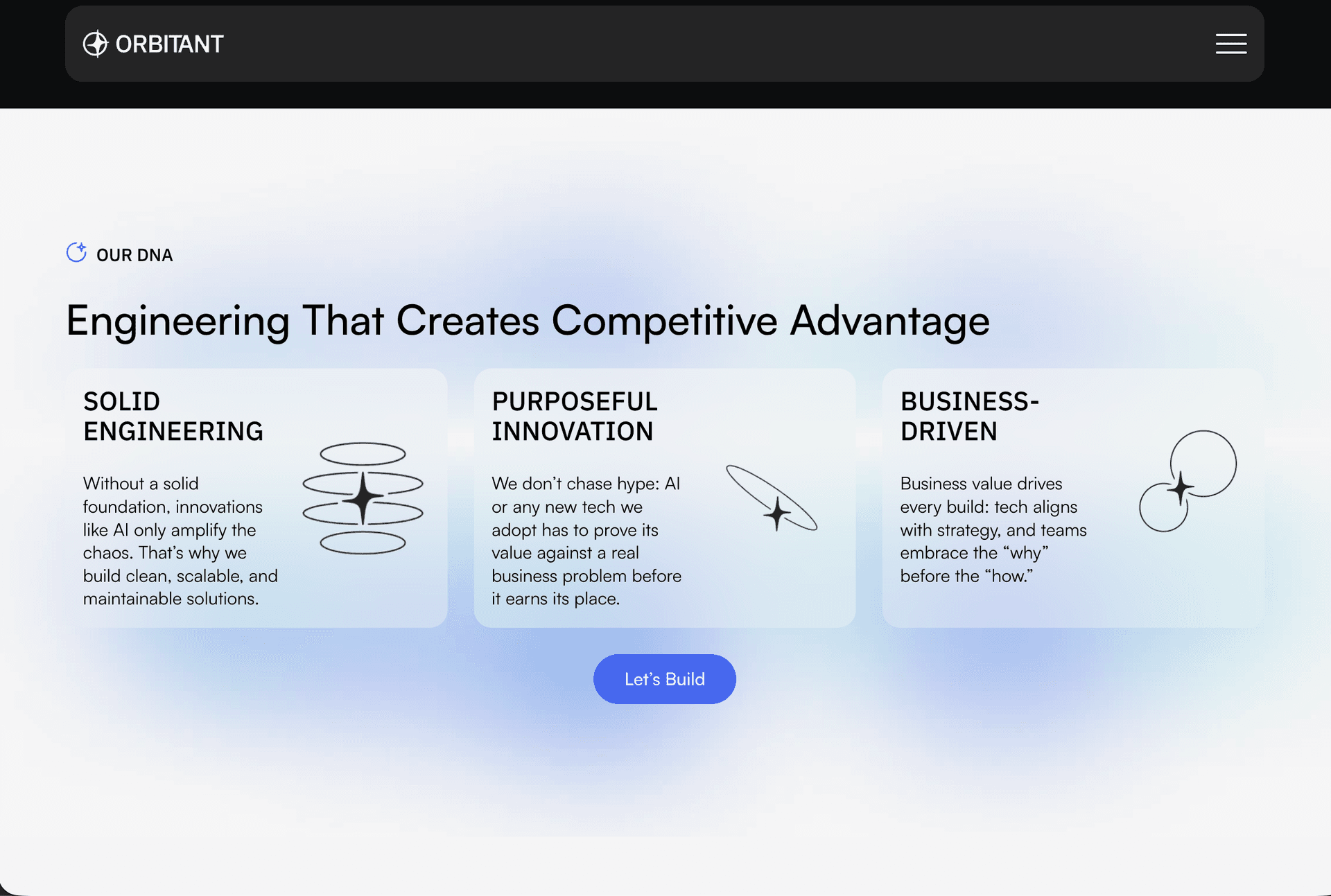
The Three Pillars of Value:
To maintain this level of autonomy, Orbitant anchors its culture on three non-negotiable pillars:
- Engineering: A foundational mastery of technical craft and software development.
- Business: Engineers are expected to adopt a product mindset. They must understand the client's P&L, software economics, and the true ROI of their code.
- Innovation: Emerging technologies like agentic workflows and AI are strictly applied to solve tangible business problems, never adopted purely for optics.
Measuring What Actually Matters
Because Orbitant engineers operate as true co-pilots - mandating daily co-presence with clients in standups—the firm has abandoned vanity metrics. Pull request counts and lines of code are irrelevant.
Instead, performance is calibrated through rigorous 360-degree assessments. Orbitant utilizes standardized Skill Dictionaries to measure both hard technical skills and soft skills like stakeholder management. This is paired with continuous mentor feedback, peer reviews, and direct Client Satisfaction (CSAT/NPS) scores.
By forcing transparency through lightweight custom tooling and daily collaboration, Orbitant ensures there are no alignment gaps. Even when technical pivots occur, clients understand the underlying business rationale because they were in the trenches making the decisions. For Orbitant, delivering code is the baseline; delivering genuine financial and operational value is the mandate.
The Pivexis Perspective: Why This Architecture Wins
Most mid-market IT firms hit a scaling wall because they attempt to scale management rather than autonomy. When expanding cross-border operations, the default industry reflex is to add layers of project managers, rigid SOPs, and hourly billing metrics to maintain control.
Orbitant’s architecture is a masterclass in doing the exact opposite.
By embedding engineers directly with the client, they have engineered a self-regulating ecosystem. They removed the communication bottlenecks and aligned their internal performance metrics directly with the client’s P&L. It takes immense organizational maturity to shift from tracking "lines of code" to tracking tangible business ROI. Orbitant proves that when you build an architecture based on transparency and high-level business acumen, trust and rapid growth naturally follows.